WPAL Website360 Smart Importer Pro
Product Overview
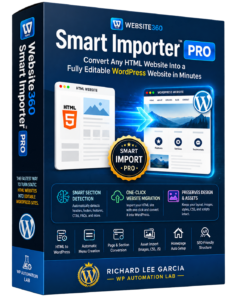
WPAL Website360 Smart Importer Pro is an HTML-to-WordPress conversion and migration tool designed to turn existing HTML websites into editable WordPress websites without requiring users to manually reconstruct every page. Traditional HTML-to-WordPress conversion can involve recreating layouts, copying content, importing images, rebuilding navigation, and reproducing page structures page by page. Smart Importer Pro automates much of this process by detecting meaningful sections of an HTML website and converting the source material into a WordPress-friendly structure.
The plugin is particularly useful for website owners migrating older static sites, agencies converting client websites, developers working from HTML prototypes, and users who have generated complete HTML websites with external design or AI tools but want the finished site to live inside WordPress.
Its smart section detection helps identify elements such as headers, hero sections, features, calls to action, FAQs, and other page components, while asset-import capabilities bring images, CSS, and JavaScript into the migration workflow. The goal isn’t just to copy a page visually, but to make the imported website usable and manageable in WordPress.
Key features include HTML-to-WordPress conversion, smart section detection, one-click website migration, design and asset preservation, automatic menu creation, page and section conversion, asset importing for images/CSS/JavaScript, homepage auto setup, and an SEO-friendly WordPress structure.